
Key Takeaways
- Responding to a lead within 5 minutes makes you up to 21x more likely to qualify them – and roughly 100x more likely to make contact – compared to waiting even 30 minutes.
- Buyer intent is time-sensitive: the psychological window for easy conversion is measured in minutes, not hours, meaning a delayed response does not just slow a sale – it often kills it entirely.
- The average B2B company takes around 47 hours to respond to a lead, a figure widely cited from foundational speed-to-lead research, with more recent analyses suggesting averages ranging from 29 to 47 hours – meaning speed alone is a legitimate competitive advantage for teams willing to close the gap.
- AI-powered tools like MAXED AI’s SwiftX can fire a personalized SMS response within seconds of a lead submitting a form – before a sales rep even sees the notification.
- Most response delays are not a people problem – they are a systems problem, and fixing the architecture is what unlocks the revenue sitting in your existing ad spend.
Most sales and marketing leaders already know they should respond to leads fast. What is harder to grasp is just how steep the drop-off is – not after a day, but after a few minutes. The gap between a 5-minute response and a 5-hour response is not a minor inefficiency. It is the difference between winning the deal and never getting a real shot at it.
78% of Buyers Go With the First Responder
There is a finding that tends to stop sales leaders cold the first time they see it: roughly 78% of buyers end up purchasing from the company that responded first. Not the cheapest. Not the most well-known. The fastest.
Speed-to-lead is not a conversion rate tweak – it is a competitive-positioning lever. When two companies sell a similar product and one reaches the buyer while they are still in the moment, and the other calls the next morning, the outcome is almost always predictable. First contact shapes perception, builds an early trust anchor, and removes the need for the buyer to keep searching.
The Numbers Do Not Lie
The data behind speed-to-lead has been studied across millions of leads, and the findings are consistent enough that directional confidence is high – even if precise multipliers vary by industry.
Contact and Qualification Odds
Respond within 5 minutes and you are roughly 100x more likely to make contact than if you wait 30 minutes. The qualification story is just as striking: MIT and InsideSales.com research – widely popularized by HBR – found businesses are approximately 21x more likely to qualify a lead when the first response happens in under 5 minutes versus 30 minutes. Most of that advantage is wiped out before the first hour is up. Research by Dr. James Oldroyd found that the odds of contacting a lead drop by over 10x if the first attempt comes after that first hour.
Conversion Rate Cliff
InsideSales-derived data shows conversion rates are roughly 8x higher when contact is made in the first 5 minutes compared to any attempt made between 5 minutes and 24 hours later. That is not a marginal gap – it is the difference between a lead that becomes a customer and one that becomes a sunk cost.
The 47-Hour Industry Average
Despite the data being widely available, average B2B response times are consistently measured in the range of 29 to 47 hours, with foundational research placing the figure at around 47 hours. Only about 7% of companies respond within 5 minutes, and a large share either take more than 24 hours or never follow up at all – with no-response rates ranging from 27% to 71% depending on the study. That gap is an opportunity hiding in plain sight for teams who treat speed as a system priority rather than a vague best practice.
Buyer Intent Decays Within Minutes
The numbers reflect something deeper: buyer psychology shifts dramatically between minute 5 and hour 5. Understanding why the window closes so fast is what turns speed-to-lead from a metric into a conviction.
The Buying Moment (0-5 Minutes)
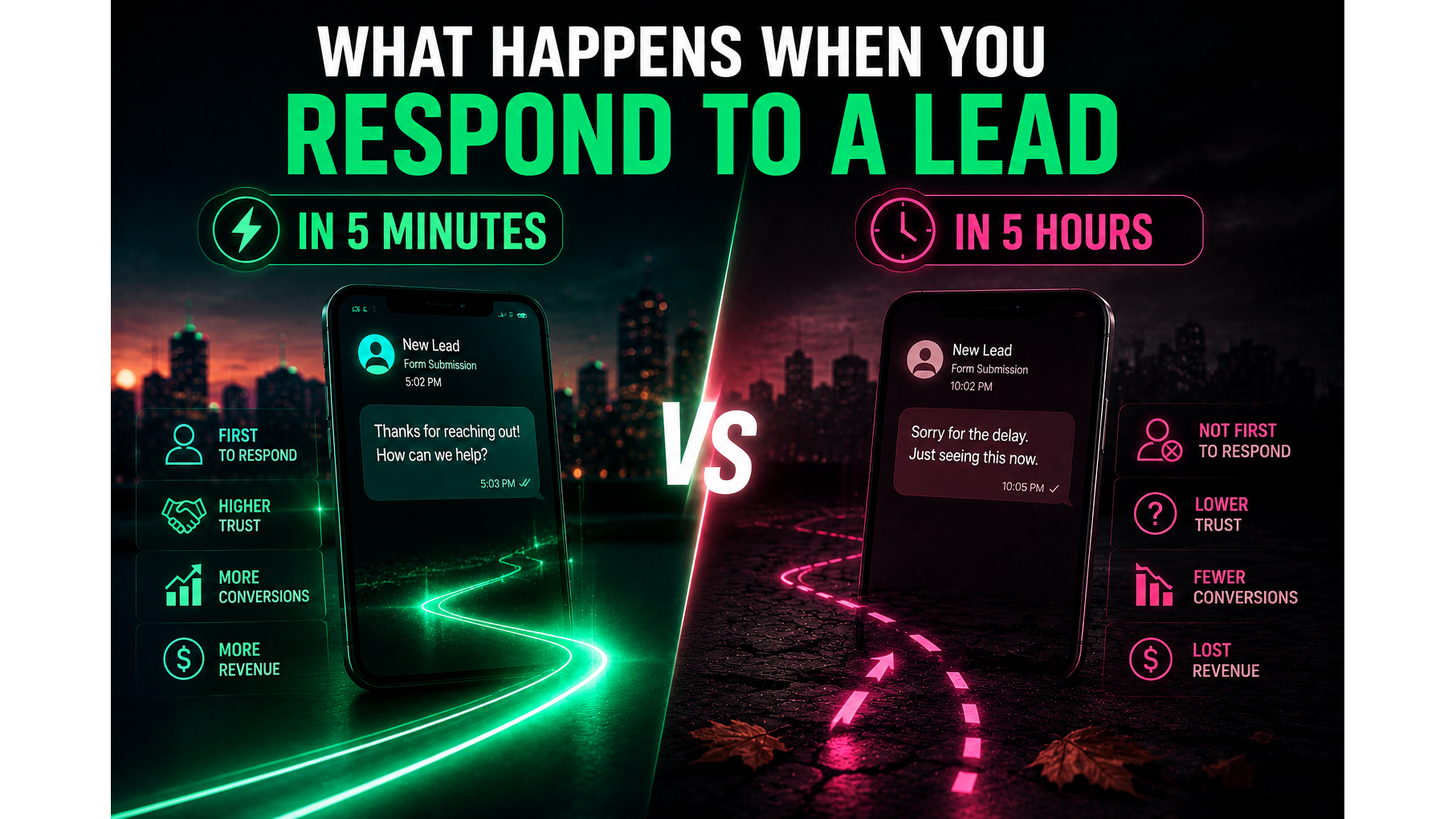
When someone fills out a form or submits an inquiry, they are in an activated state. The problem feels urgent. The offer is fresh in their mind. Details are sharp, so qualification conversations flow easily. A fast response at this moment does not just catch them at the right time – it signals competence and reliability before the first real conversation even begins. That trust anchor is worth more than most teams realize.
The Inertia Trap (Beyond the First Hour)
By the time a 5-hour response lands, the buyer has moved on mentally. Other tasks have intervened. They have Googled alternatives, maybe spoken to a peer, and your offer is now one of several they are weighing. The initial urgency has faded – and behavioral science explains why this matters: temporal discounting means the perceived value of solving a problem declines as time passes. Add in the subtle suspicion that a slow-responding company will be slow at everything else, and the momentum that made the lead valuable in the first place has quietly evaporated. A 5-minute response rides the buyer’s emotional impulse. A 5-hour response has to fight buyer inertia, cognitive overload, and growing skepticism – all at once.
Why 5 Hours Becomes the Default
Most organizations do not choose slow response times. They drift into them through accumulated operational friction that nobody has formally diagnosed or fixed.
Fragmented Systems and Manual Routing
Leads arrive through web forms, landing pages, ad platforms, chat tools, and phone lines – each with its own notification logic and owner. No single person sees everything in real time. Lead assignment happens through spreadsheets, email forwards, or CRM queues that get checked on batch schedules rather than continuously. Industry analysis confirms this: lead leakage – where leads are generated but never effectively followed up – is caused primarily by inefficient internal processes and a lack of real-time visibility into lead status, not by bad leads.
Staffing Gaps During Peak Hours
Ads run 24/7. Sales teams do not. Nights, weekends, and the lunch window are where response times spike – and where competitors who have automated their initial outreach quietly win the leads that were already paid for. Without explicit speed-to-lead SLAs and reporting, leaders see pipeline volume but not latency. They treat response time as a vague best practice rather than a measurable revenue variable.
The Real Revenue Delta
The economic case for speed-to-lead becomes very clear once the conversion math is made explicit.
Speed as a CAC Multiplier
Consider 100 inbound leads per month from paid campaigns. Sub-5-minute responses make you 21x more likely to qualify each lead and 100x more likely to make contact compared to a 30-minute-or-more response pattern – a difference that translates directly into a far larger share of converted customers from the same spend. At a $2,000 average sale value, the monthly revenue delta between fast and slow response is substantial. At higher ticket sizes common in SaaS or financial services, the gap scales further. Slow response does not just cost conversions – it inflates effective customer acquisition cost (CAC), making paid acquisition look expensive when the real issue is conversion efficiency. Every lead that goes uncontacted within the window is a lead that was paid for twice: once to generate, once to ignore.
How AI Closes the Gap Instantly
Hitting a consistent 5-minute response window across all lead sources and all hours of operation is essentially impossible with human-only workflows – which is exactly why modern speed-to-lead strategies depend on automation.
AI-Powered Sub-Second Lead Response
AI-powered tools can now initiate contact, qualify prospects, and schedule appointments within seconds of a form submission – 24/7, with no staffing gaps. Automated lead routing systems can instantly assign leads to the right sales rep based on predefined criteria, eliminating the manual handoff delays that account for most response-time leakage. Businesses implementing AI-driven speed-to-lead solutions have reported significant lead-to-opportunity conversion rate improvements, with AI’s ability to respond instantly and qualify prospects driving measurable gains. MAXED AI addresses this specific problem with SwiftX, which fires an SMS to a new lead within seconds of form submission – holding a real qualifying conversation and booking an appointment before a sales rep has even seen the notification. The result: reps make warm calls rather than cold ones, and no lead falls through the cracks because of a staffing gap or a slow queue.
Why Concise, Conversational SMS Outperforms Email
The channel choice matters as much as the timing. SMS open rates consistently exceed 90%, and the medium creates an expectation of a real, two-way conversation. Personalized, concise messages – rather than generic automation blasts – are what drive the reply rates that actually matter. Reply rates of 30-50% on well-crafted SMS outreach are significantly higher than the typical 2-3% reply rates of email campaigns. The reason is straightforward: email is easy to defer. A well-crafted SMS triggers an immediate read and a natural impulse to respond – which is exactly the behavior needed to restart a conversation while buyer intent is still alive. The model that works best uses AI to provide instant acknowledgment and basic qualification, then hands off to a human for the consultative close. Speed captures the window; human depth closes the deal.
Speed Wins – Build Systems That Deliver It
The 5-minute vs. 5-hour comparison is not really about sales technique – it is about operational architecture. The teams winning on speed-to-lead are not working harder; they have built systems that make slow response structurally impossible. That means unified lead routing, clear SLAs with actual reporting, automation that covers every hour of the week, and AI-assisted initial contact that keeps leads warm until a human can step in. Speed is the currency of modern lead conversion. The window is narrow, the data is unambiguous, and the competitive advantage belongs to whoever shows up first – with a message worth reading.
For sales and marketing leaders ready to close the response time gap, MAXED AI builds AI-powered sales systems designed to engage, qualify, and convert leads the moment they raise their hand.
MAXED AI
13801 N Scottsdale Rd
#151-17
Scottsdale
Arizona
85254
United States


