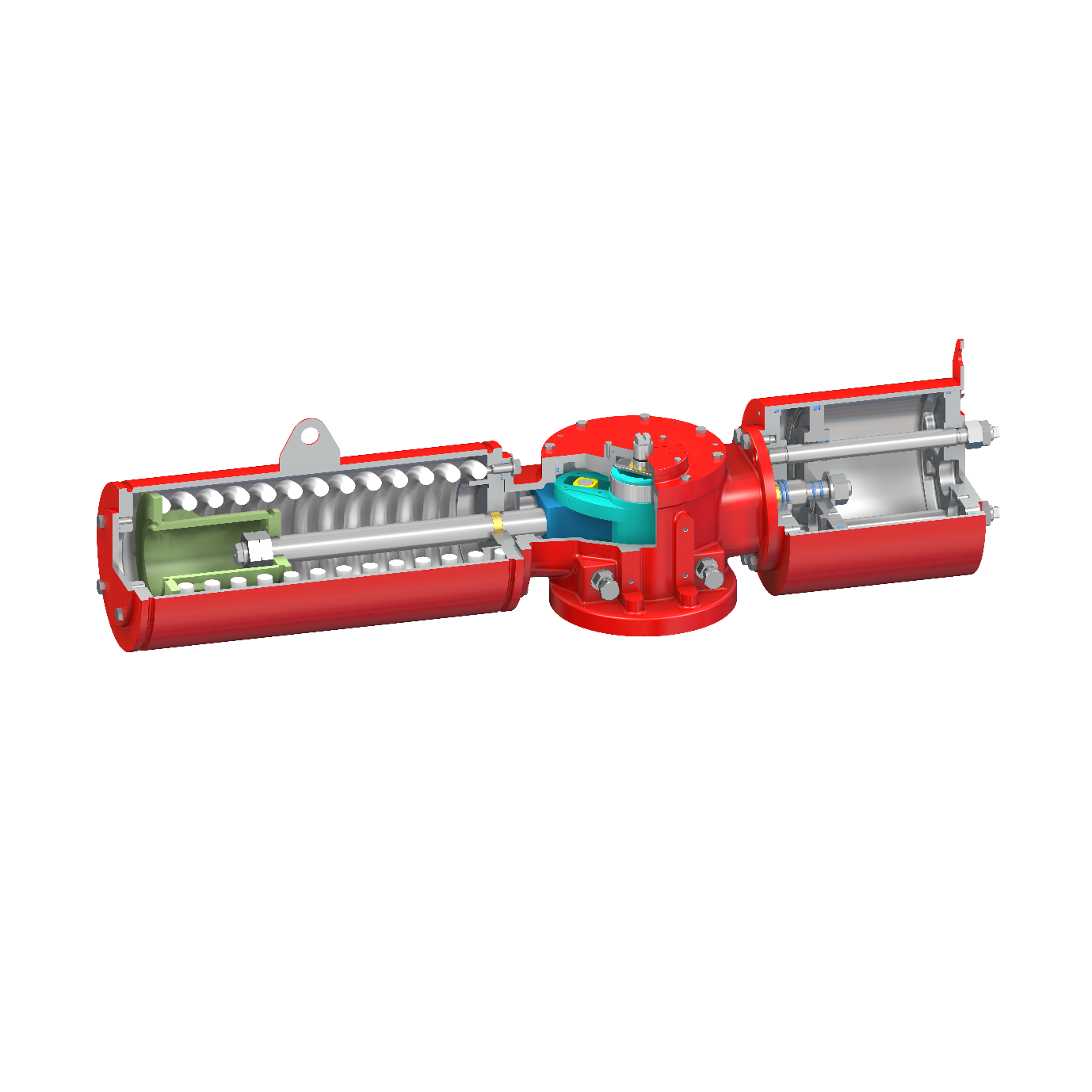
SUZHOU, JIANGSU, CHINA, August 28, 2026 /EINPresswire.com/ — When process plants require reliable fail-safe operation, STARD GEARS provides the mechanical foundation and quality control for safety-focused valve automation projects through its ESD Actuator solutions. Using YP Series spring-return Scotch Yoke mechanisms, torque testing, and staged quality control, the manufacturer supports valve-load planning and defined failure directions. The YP Series is listed as SIL 2 / SIL3 capable, but project-level functional safety approval still requires the applicable model scope, safety documentation, and calculated PFD/PFH data for the installed configuration.
ESD Actuator Guidance Starts with a Written Safety Requirement
The selection process for any emergency shutdown system begins with a documented safety function rather than a generic hardware request. Project teams must define the valve’s safe position, triggering conditions, required stroke time, load capacity, and target Safety Integrity Level (SIL) before evaluating options. Without this foundation, treating “fail-safe” as an abstract label creates gaps in plant protection, leaving critical pipelines vulnerable during power or utility failures.
The YP Series spring-return Scotch Yoke architecture provides the robust mechanical basis for emergency action upon air loss, making it suitable for 90° valves in demanding environments. While double-acting designs work for normal control, emergency shutdown functions require a stringent evaluation of air-loss states, reserve air storage, and failsafe direction to guarantee closure or opening. Combining these capabilities with precise torque profiles and accessory logic lets engineers develop actionable safety strategies. STARD GEARS supports these requirements with YP models operating reliably at 3–7 barg working pressure across temperature configurations, ensuring the actuator matches the exact safety requirement.
Spring-Return Sizing Must Use Worst-Case Torque and Minimum Air Pressure
An emergency shutdown actuator only fulfills its safety mandate if it can reliably overcome maximum mechanical resistance under the most restrictive utility conditions. Engineers must size spring-return models to verify both pneumatic and mechanical spring strokes against the lowest available plant air supply, highest valve torque, and worst-case friction variables. Over-sizing can damage the valve stem, while under-sizing risks failure to close during an emergency. Environmental factors like extreme cold can alter friction coefficients, requiring appropriate safety margins during initial engineering.
To address varying valve characteristics, STARD GEARS offers optional symmetrical or canted yoke designs. This structural flexibility allows engineering teams to match the mechanical output curve to specific break, run, and seat torque requirements, guaranteeing sufficient force at the critical seating point. The pre-compressed spring module establishes the foundation for the loss-of-power return stroke, while a non-pressure retaining end cap reduces disassembly risks during maintenance. Furthermore, the final emergency stroke time must undergo testing under actual operational conditions, accounting for flow rates and exhaust capacity. Utilizing the standard 90° travel with ±5° adjustment ensures complete valve closure.
SIL3 Planning Requires Evidence Beyond A Capability Statement
Declaring a component SIL 3 capable only holds meaning when detailed safety documentation matches the physical actuator and its accessory configuration. Procurement teams working on SIL3 projects must look beyond marketing statements and cross-check the safety manual, Probability of Failure on Demand (PFD) or Probability of Failure per Hour (PFH), Hardware Fault Tolerance (HFT), diagnostic coverage, and precise validity scope of the certificate. EPC contractors and operators rely on this data to integrate the pneumatic actuator with the distributed control system (DCS) and safety instrumented system (SIS).
Because the mechanical valve actuator cannot represent the entire safety loop alone, the logic solver, feedback devices, and solenoid valves influence the final Safety Integrity Level (SIL) calculation. The safety documentation must correspond to the installed actuator model and accessory configuration. Any modification, accessory replacement, or proof-test change requires review of the safety calculations and certificate scope before the loop can be treated as unchanged.
Quality Controls And Testing Support Repeatable ESD Delivery
The long-term reliability of an emergency shutdown system depends on manufacturing consistency just as much as initial mechanical design. STARD GEARS establishes a reproducible manufacturing baseline for its ESD actuators through design verification, phased quality control, torque testing, and life cycle testing. This systematic approach ensures the delivered unit performs exactly like the unit that passed prototype certification.
Before a product enters mass production, the engineering team utilizes 3D simulation and finite element analysis (FEA) to confirm structural integrity and performance margins under maximum load conditions. Once in production, strict quality control protocols cover incoming materials, in-process machining, and final assembly. However, standard factory testing serves only as the baseline; project-specific Factory Acceptance Testing (FAT) should be supplemented according to the safety function. This expanded FAT incorporates loss-of-air stroke tests, strict timing verifications, end-position checks, and accessory interlock trials to validate the package before deployment.
A Complete ESD Data Package Enables Lifecycle Management
Delivery of an emergency shutdown actuator extends beyond physical hardware to include a comprehensive data package supporting initial installation, periodic proof testing, preventative maintenance, and long-term change management. This documentation ensures the safety function remains verifiable and auditable throughout the equipment’s operational life, preventing compliance failures during safety inspections.
The final delivery package must encompass the exact model number, spring configuration, torque calculations, accessory lists, dimensional drawings, safety certificates, test records, and maintenance procedures. In the field, personnel should log testing frequencies, actual stroke times, and repair activities, as deviations from baseline performance must be managed through the facility’s functional safety system. When maintenance requires spare parts, replacements must maintain the exact same safety scope as the originally approved configuration, preserving model integrity for future safety audits. An undocumented seal replacement can compromise traceability.
ESD Lifecycle Management Starts with Traceable Safety Inputs
Maintaining verifiable safety performance requires that safety requirements, model selection, test records, maintenance cycles, and change controls remain fully traceable from initial procurement through operation. For the mechanical hardware, manufacturing traceability is established through staged QC and documented test records, which support the claim of production consistency and material traceability.
Achieving true functional-safety traceability also demands documented safety requirements, formal SIL assessments, and strict change control procedures at the plant level. Without this continuous thread of documentation, operators cannot prove their emergency shutdown systems will function as designed when an abnormal process event occurs. Project teams planning safety-focused valve automation can contact STARD GEARS to request the precise technical data package corresponding to their target ESD architecture. By integrating reliable manufacturing records with rigorous functional safety assessments, engineers can maintain their plant’s emergency shutdown capabilities and protect critical infrastructure from unpredictable disruptions.
To discuss specifications, request safety documentation, or select the correct spring-return mechanism for your next project, visit the official website at https://www.stard-gears.com/.
Suzhou SIP Stard Automation CO.,LTD.
STARD GEARS
email us here
Visit us on social media:
LinkedIn
YouTube
Legal Disclaimer:
EIN Presswire provides this news content “as is” without warranty of any kind. We do not accept any responsibility or liability
for the accuracy, content, images, videos, licenses, completeness, legality, or reliability of the information contained in this
article. If you have any complaints or copyright issues related to this article, kindly contact the author above.

Media gallery