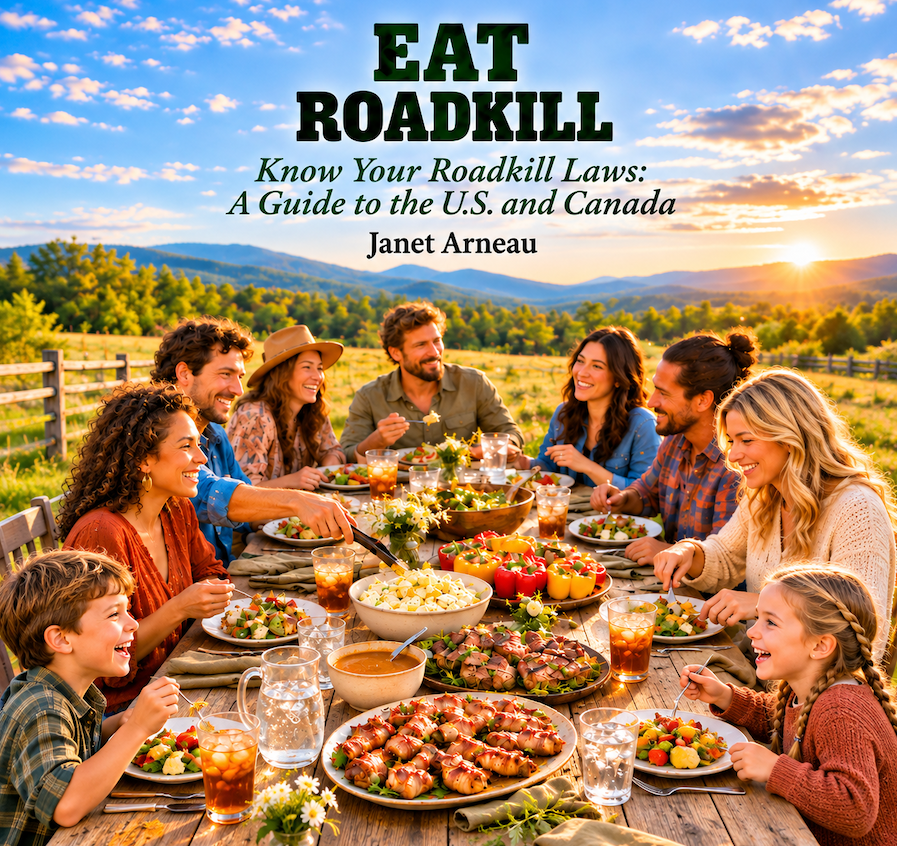
Eat Roadkill, ‘Know Your Roadkill Laws’, guides readers through U.S. and Canadian roadkill recovery, preparing families for venison at the Thanksgiving table.
MT PLEASANT, SC, UNITED STATES, November 17, 2026 /EINPresswire.com/ — November is the month U.S. drivers are most likely to collide with a large animal, according to State Farm’s 2026 analysis. They also report more than 1.6 million animal vehicle collision insurance claims occurred nationwide between July 2025 – June 2026. The lowest possible statistic, the other 700 U.S. auto carriers do not release animal collision claims publicly. Deer being the most frequently struck, the statistic raises an important question: When a deer becomes roadkill, can the meat be legally and safely recovered rather than wasted?
With over 400 media companies reporting on National Roadkill Day, celebrated September 25th, and the release of Roadkill Art’s first book “Yellow Line Dining” the attention of millions of interested readers was sparked. National platforms, television-stations, websites, regional publications and syndication networks distributed the news that roadkill is a possible sustainable meat source. The media exposure for a subject that rarely enters mainstream food conversations demonstrated the readiness of America to look beyond assumptions that roadkill is gross and learn more about the potential value of legally recovered roadkill for consumption.
Roadkill Art’s new publication, “Eat Roadkill”, Know Your Roadkill Laws: A Guide to the U.S. & Canada, examines roadkill recovery laws throughout the United States and Canada, helping readers understand legal requirements. Roadkill retrievers should be able to bring meat home with confidence, knowing they have followed the rules, rather than looking over their shoulder and wondering whether the animal they have already processed could be confiscated. The book is an extension of, ‘Yellow Line Dining’: America’s Untapped Wild Food Source, Find It. Cook It. Eat It., which introduces readers to the assessment, processing, and preparation of legally recovered roadkill.
Together, the two books address: legally recovering a roadkill and determining whether a roadkill is suitable for food.
Roadkill Art teaches four test through its TTTS approach in’ Yellow Line Dining’:
Time — How long has it been since the collision?
Temperature — What temperatures has the roadkill been exposed to?
Trauma — Where was the roadkill struck, and how extensive are the injuries?
Spoilage — Are there signs the meat has begun to spoil?
These questions are part of a broader food safety assessment. If ever in doubt a roadkill is safe to consume seek experienced assistance. Recovering roadkill is not as simple as stopping and loading it into a vehicle. Knowing the law and determining whether a roadkill is suitable for consumption requires knowledge and careful assessment.
Through the free Roadkill Art app, members can report roadkill, view reports on the Map View or List View for retrieval, look up state recovery regulations and explore wild game recipes in the ‘Yellow Line Diner’. App members are able to communicate and seek out information from other more experienced members within a posted report. Deer roadkill is a valuable source of lean meat providing protein, zinc and Omega 3 due to the deers healthy free range diet. Roadkill Art provides the law, understanding safety considerations, and experienced guidance for retrieving a healthy meat that can provide numerous meals.
Thanksgiving centers on turkey, but venison has a long history in American food traditions. At the 1621 harvest celebration in Plymouth, the first Thanksgiving, the Wampanoag tribe brought 5 deer to share with the Pilgrims during the three-day feast.
The Roadkill Art website has many recipes to choose from, a venison roast with cranberry glaze is impressive or a hearty venison shepherd pie loved by kids. The possibilities are extensive for introducing roadkill to the Thanksgiving menu. For families interested in sustainable food, learning about legally recovered venison offers a fresh perspective on a valuable food source that often goes unused. ‘Eat Roadkill’ is the tool for curious newcomers, roadkill hunters, and households ready to supplement food supplies with game meat from roadkill.
With the abundance of roadkill produced in November, its an opportune time to utilize roadkill. Adding a wild game dish this season could become a memorable part of Thanksgiving dinner. Take the time, ‘Stop for Roadkill’, and know the roadkill law before getting there.
Roadkill Art wishes all a very Happy Thanksgiving!
‘Eat Roadkill’ and ‘Yellow line Dining’ are available on Amazon in paperback and Kindle editions and at RoadkillArt.us.
Janet Arneau
Roadkill Art
+1 917-957-3005
Visit us on social media:
LinkedIn
Instagram
Facebook
Other
Legal Disclaimer:
EIN Presswire provides this news content “as is” without warranty of any kind. We do not accept any responsibility or liability
for the accuracy, content, images, videos, licenses, completeness, legality, or reliability of the information contained in this
article. If you have any complaints or copyright issues related to this article, kindly contact the author above.

Media gallery